Showing posts with label Seasonal. Show all posts

Sunday, 20 January 2013

Marmalade Making

I spent last weekend peeling, chopping, squeezing, boiling and decanting. The result was 11 jars of homemade marmalade, and quite delicious it is too! I had never made marmalade before, and there were no shortage of recipes to choose from - it seems that marmalade recipes are, quite rightly, a great source of pride to their authors, having been honed and refined every January, year after year. Everyone seems to more or less agree on the proportions - 1 part Seville oranges, 2 parts water, 2 parts sugar and about 1 lemon per kg of oranges. It's the method that causes disagreement - to cut the orange peel chunky or to shred it finely? To soak overnight or boil the oranges whole? To set the preserve to a firm jelly or leave it a little runny? It's a minefield for a marmalade novice like myself, but after a certain amount of research I decided to follow Nigel Slater's Recipe from his 'Kitchen Diaries II', along with occasionally consulting Dan Lepard's in-depth discussion of the method and science of marmalade making.

Seville oranges, the bitter variety that we need for marmalade, are in season during January and early February. It's worth seeking out organic, unwaxed fruit (not hard to find - Waitrose stock them, and I'm sure any decent greengrocer will too) as you are going to be using the peel as well as the pulp. I got particularly lucky when I bought mine - the cashier decided that because they were knobbly and green-tinged they must be a bit dodgy, and try as I might to explain that they were a special type of orange she insisted on giving me a discount on them. If you insist! Golden granulated sugar seems to be the sugar of choice, with some people adding a little black treacle at the end of cooking to produce a characterstic dark coloured preserve. You don't need jam sugar with added pectin, because the oranges (specifically the pith and pips) naturally contain enough pectin to set the marmalade.

Anyway, the method involved first peeling your oranges (10 of them) and lemons (2 of them):


Then chopping up the peel to your desired thickness. This is probably the most labour-intensive part of the process - it took me over half an hour to chop up all the peel, but it does fill the kitchen with wonderful citrus scents.

Chop chop!

The peel then goes in a bowl (or two bowls if, like me, you don't own a bowl big enough) along with 2.5 litres of water, the squeezed juice from the fruits, the pulp (chopped) and the pips (tied up in a muslin bag). This gets left to soak for 24 hours, to release the pectin from the pith and pips.


The next day, the peel, pulp, pips and water get transferred to a pan and boiled for about 2 hours until the peel is soft enough to squish between two fingers. After that, the bag of pips is removed, the sugar is added and the mixture is boiled (skimming off any froth that bubbles up) for 15-45 mins until set (this is tested by putting a tablespoon of the mixture on a saucer and chilling in the fridge for a few mins - if it forms a skin it's ready. Alternatively, use a sugar themometer - the setting point is 105C). When the marmalade boils it does tend to froth up, so you must have a big enough pan so that it won't bubble up over the sides, burning your hands and ruining your hob - I decided my stockpot wasn't quite big enough so I made the marmalade in two batches, straining the peel (but reserving the liquid) after the initial 2 hours of boiling, weighing out the peel and liquid into half quantities. Bit of a faff, so perhaps a big preserving pan might be a good investment in future! Once the marmalade has reached setting point, it's a good idea to leave it for 10 mins so that the peel is evenly distributed throughout the preserve.
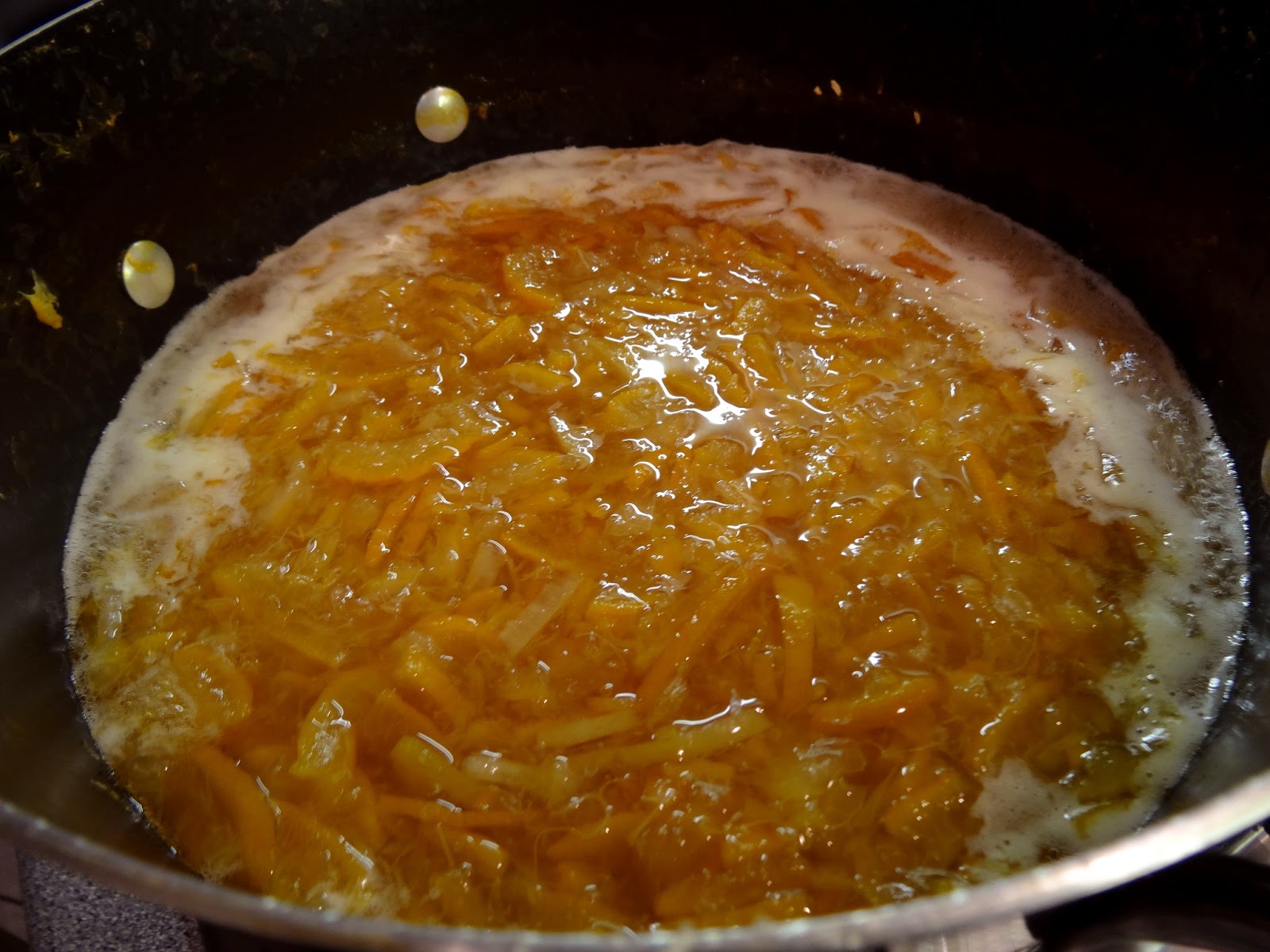
Marmalade comes up to the boil

Finally, the marmalade is decanted into sterilised jars, and left to cool. After that, all you have to do is look forward to breakfast the next morning!
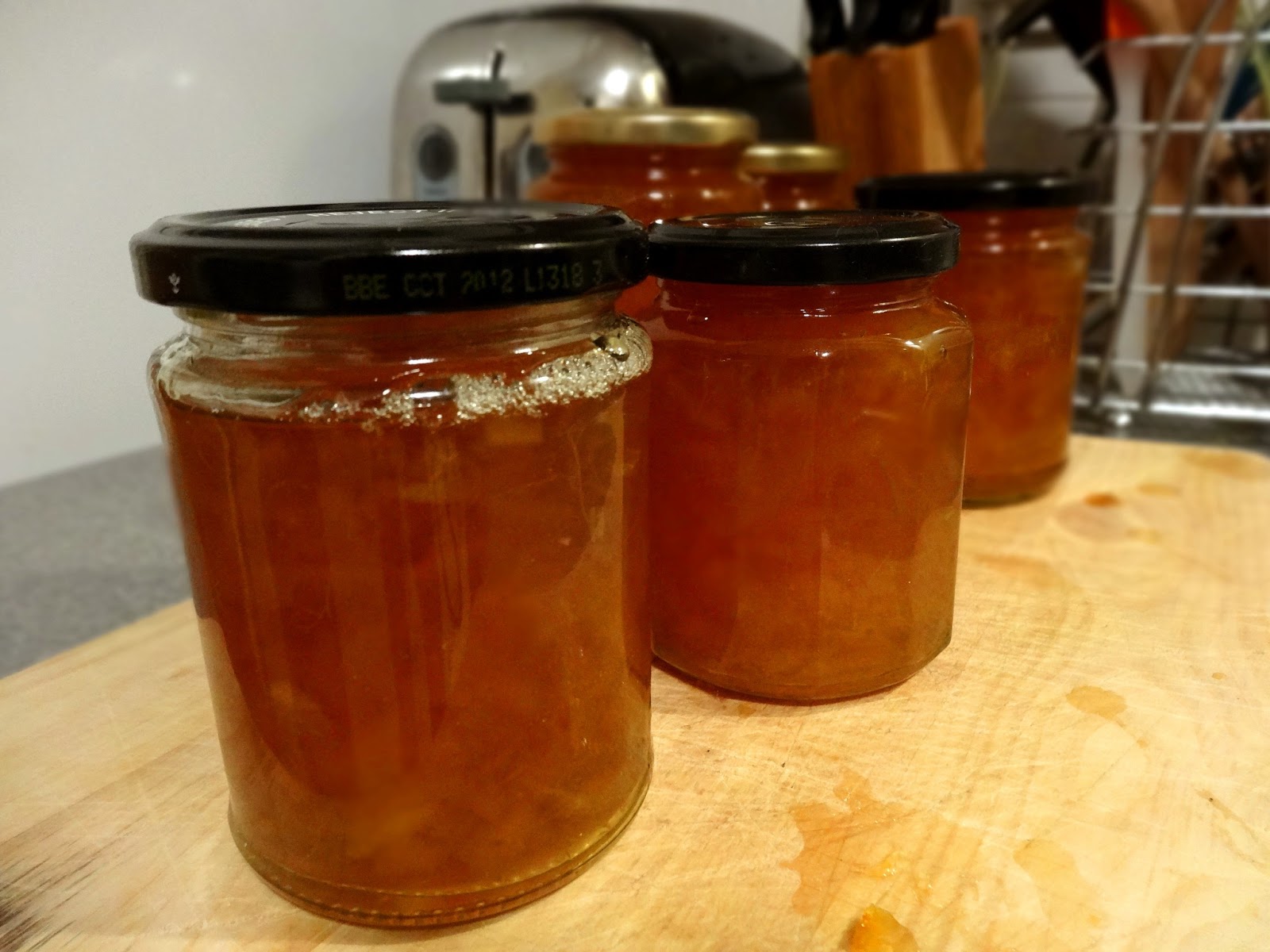
Done!

Saturday, 12 January 2013

A Salad of Jerusalem Artichokes, Cabbage, Mushrooms and Hazelnuts

A nice winter salad this one – Jerusalem artichokes arrived in our veg bag this week, and a bit of googling tells us that they are not, in fact, an artichoke, nor are they from Jerusalem – they’re a member of the sunflower family. The knobbly tubers are similar to potatoes, but much harder to peel because they’re so god-damn knobbly. Quite an unique taste – sweet and distinctively nutty, in the kitchen they behave much like potatoes. You can boil ‘em, roast ‘em, gratinate ‘em, mash ‘em and probably even make chips with ‘em. I opted for the par-boil and roast option (along with a few fat cloves of garlic), roasting for about half an hour til they turned a bit crispy and caramelised. Team them up with some lightly boiled savoy cabbage, some slowly sautéed onion and mushroom, some toasted hazelnuts (half of them bashed until they crumble), a good dressing of olive oil and apple balsamic, and a warm slice of buttered toast and you have a light, unusual, and really rather classy supper.


The only thing to bare in mind here is that jerusalem artichokes, while delicious, rival even swede and baked beans with their ability to make you fart. Not necessarily a problem in my book, but if you’re expecting company then perhaps they’re not the veg of choice…..

Squash, Apple and Cider Soup

A real seasonal bowl of soup this one – and a result of consulting several different soup recipes involving pumpkins/root veg and cider. I used a couple of small harlequin squashes, and a cooking apple, with onion, garlic, allspice, ground ginger, nearly a whole bottle of organic dry cider and enough stock to cover the veg. Caramelising the onion at the start rather just sweating it seemed to add a nice flavour. When the squash was soft the soup was blended, cream stirred in and garnished with cox apple slices, fried in a little oil and butter until brown, and then seasoned with a little cinnamon and a pinch of brown sugar.


Pigeon Breast, Pearly Barley with Bacon and Leeks, Honey Roasted Carrots and Swede

I’d never cooked pigeon before – what a tasty bird! Similar to venison or lean beef (and, in my opinion, far more interesting than both) pigeons are a plentiful source of delicious meat, and cheap as a result – we picked up 2 ‘oven ready’ pigeons for £5 at the farmer’s market. You can cook pigeons on the bone, either roasted or casseroled, but I chose to de-breast the birds with a sharp knife (there’s not much meat other than the breasts themselves). The carcasses weren’t wasted though – they got 10 mins in a hot oven and then straight into the stockpot with carrot, onion, celery, leek tops, bay leaves, black peppercorns, parsley and thyme and simmered for a couple of hours. Half of the resulting stock was then used for the pearl barley and red wine sauce, the other half sits in the freezer awaiting further instructions!


For the pigeon:
2 wood pigeons, breasts only, carcasses made into stock

For the Pearl Barley:
200g pearl barley
A rasher or two of bacon
1 leek, chopped
1 clove of garlic, finely chopped
Some cabbage, shredded and blanched
Butter and rapeseed oil
Flat leaf parsley
Pigeon stock (approx. 400ml)
For the honey roast carrot and swede:
2 large carrots
1 swede
1 onion
Runny honey
Rapeseed oil
For the red wine sauce:
Half a glass of red wine
A splash of pigeon stock
1 tablespoon of redcurrant jelly
Dice the carrot and swede, thickly slice the onion, place on a baking tray, season well with salt and pepper and drizzle with rapeseed oil. Roast at 200C for about 45 mins or until the veg starts to caramelise. Meanwhile, for the pearl barley, slice the bacon into lardons and fry in plenty of butter and rapeseed oil. When it starts to brown, add the chopped leek and garlic, fry for a couple of minutes then add the pearl barley and stir to coat in the oil. Pour in about half the stock, cover with a lid and allow it to simmer. When most of the stock has been absorbed add a splash more, repeat until the barley is tender.
Get a frying pan on a high heat. Season the pigeon breasts with plenty of salt and pepper, and rub with rapeseed oil. Add a little oil to the pan and fry the breasts for 5 minutes, turning every minute or so. Remove from the pan and leave to rest on a plate, covered in foil. Keep the pan on the heat, pour in the red wine and stir to deglaze. Add in a ladelful of pigeon stock and a tablespoon of redcurrant jelly and simmer for about 10 minutes until reduced. Get the roast veg out of the oven and drizzle a little honey all over the veg. Return to the oven for about 10 mins until glazed. Add the blanched cabbage to the pearl barley, season with salt and pepper to taste, and stir in a knob of butter and some chopped parsley. Slice the pigeon breasts at an angle – they should be nice and pink in the middle. Serve on top of the pearl barley, scatter the honey roast veg around it and drizzle the pigeon with the reduced sauce from the frying pan.


I was really chuffed with this one – pigeon is an absolute delight, and the earthy, autumnal flavours of the barley and veg seem to complement it very well.