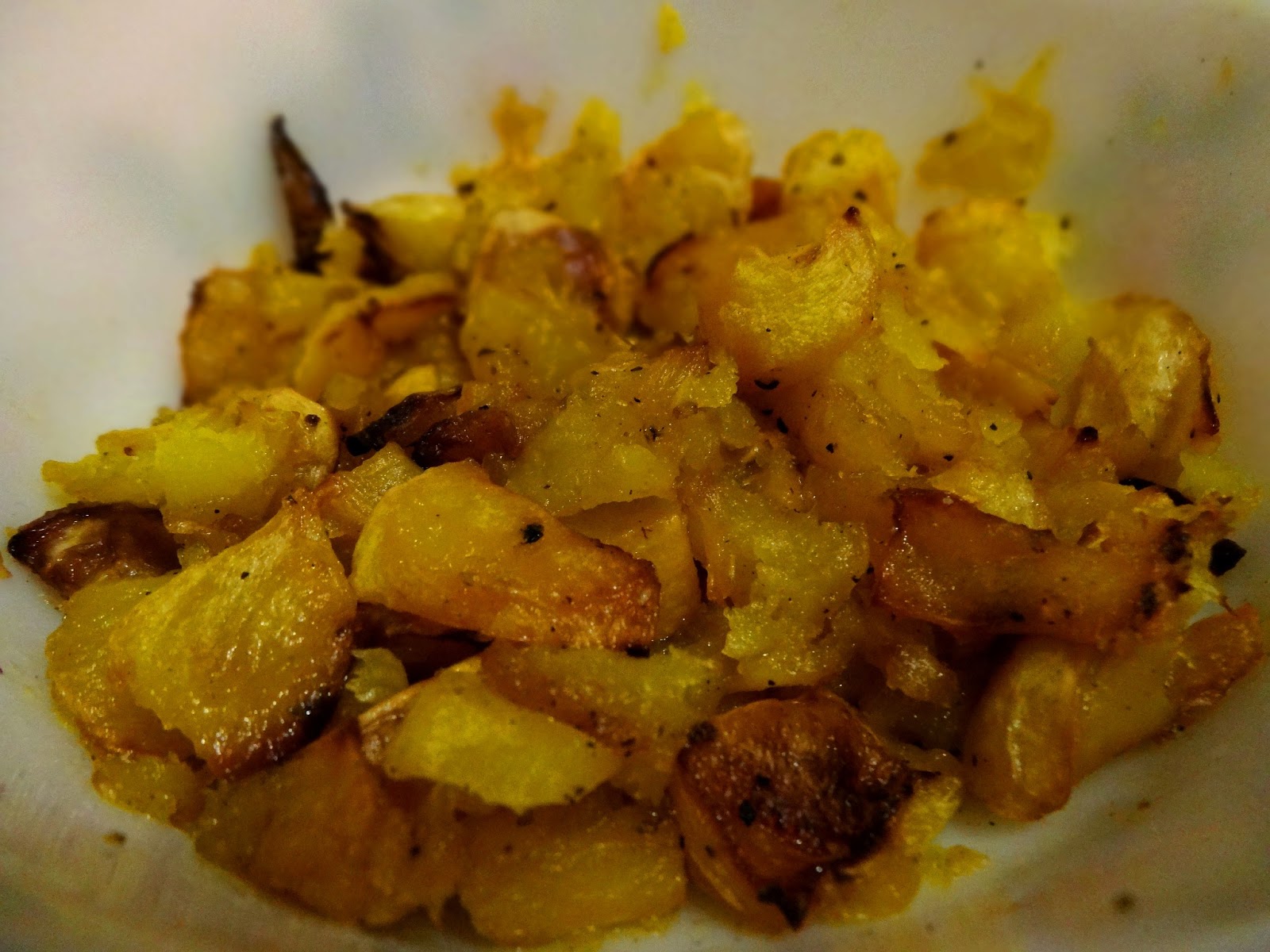
It's great toasted and buttered, and I reckon any stale leftovers would be great in a bread and butter pudding (not that there's much chance of stale leftovers in this house!).
Thursday, 31 January 2013
Challah Bread
After the fun of plaiting a loaf last week I thought I'd have a go at baking Challah - a traditional Jewish type of bread which is somewhere between a normal white loaf and a brioche - the dough is enriched with eggs and a little milk and sugar, which makes it deliciously rich without losing the light airiness that we associate with yeasted breads. I followed Paul Hollywood's recipe for this, using a three strand plait shape - a total breeze after the eight strand fun last week! The shaped dough is egg-washed, left to prove and then baked for about 25 minutes. It does take on colour quickly so it's worth watching it - I put a sheet of foil over mine after the first 15 minutes to stop it browning any further. Here it is in all its glory:
Location:
Newcastle upon Tyne, Tyne and Wear, UK
Sunday, 27 January 2013
Burns Night
25th January - the one day of the year when, traditionally, Scottish people are allowed to consume more alcohol and saturated fat than is recommended by their doctor....
I have a real fondness for Burns Night, perhaps because as an expatriate Scot living in the North East of England I feel I ought to celebrate my Scottish roots when I can, lest I become converted to the ways of the 'sassenach'! I like the fact that the food we eat for this celebration isn't the excess of the prime cut of meat or the enormous roasted bird that we associate with other annual festivities - in true Scottish spirit the haggis is a humble, thrifty food that all of us can afford, and in my view every bit as delicious as leg of lamb or a roast turkey. The main ingredients, of course, are the heart, liver and lungs from a sheep, plus beef suet, oatmeal, onion and spices. We get a little squeamish at the idea of offal these days - haggis comes from a time when we would never have dreamed of wasting any part of an animal, especially not when it tastes so good. Team this "chieftain o' the puddin' race" with 'bashed neeps' (mashed swede) and 'champit tatties' (mashed potato) and you have a meal fit for Rabbie himself, for little more than £1.50 a portion. For our Burns night we had a three course Scottish feast. First up, homemade oatcakes:
....with some Strathdon Blue highland cheese, homemade chutney and mustard pears:
Next, the main event! Macsween haggis, honey roasted 'bashed' neeps, buttery 'champit tatties' and a whisky cream sauce:
| Bashed Neeps |
| The Chieftain |
| Making the first incision |
| Gently does it! |
| Thar she blows! |
| Let battle commence! |
And, to finish, a seasonal take on a classic Scottish desert - Rhubarb and Whisky Cranachan! Rhubarb, honey, whisky cream and toasted oats in perfect harmony:
Happily, we had leftover haggis for the next day, which naturally enough found itself on top of a pizza, along with the rest of the strathdon blue and some shredded brussels sprouts. Even I was dubious about the wisdom of this combination, but I'm happy to report that it was delicious, although I fear it may not catch on in Italy:
| Just like Granny used to make...? |
Oh, and we had a little leftover rhubarb and cream, so a 'deconstructed cranachan' followed:
A good weekend for food, a bad weekend for my arteries!
Location:
Newcastle upon Tyne, Tyne and Wear, UK
Saturday, 26 January 2013
Broccoli Pasta
I do enjoy the challenge of creating a satisfying meal from whatever you have in your fridge and cupboards. This was a good way of using up some broccoli that needed eating, and it required nothing more than what most people already have in their cupboards.
Serves 2
Half a head of broccoli, broken into small florets
1 onion, sliced
1 garlic clove, finely chopped
Parmesan
A little full-fat milk or cream
Herbs (parsley, basil, oregano - whatever you have to hand)
Olive oil
Salt and pepper
200g Pasta
1) Get a large pan of salted water on the boil. Cook the broccoli in the water for about 5 mins or until just tender. Remove it with a slotted spoon, leaving the pan of water on the boil. Add the pasta to the water and cook until 'al dente'.
2) Sweat the onion in a little olive oil until soft. Add the garlic, fry for a minute. Add the cooked broccoli, stir to coat in the oil, then add the milk, parmesan (to taste) and herbs. Remove half of the contents of the pan and blend until smooth. Return to the pan. Season the sauce with salt, pepper and more parmesan to taste. If it's too thick add more milk or some of the pasta cooking liquid. Stir into the pasta, serve with more parmesan and black pepper.
| Very green! |
Labels:
Pasta,
Storecupboard,
Vegetarian
Location:
Newcastle upon Tyne, Tyne and Wear, UK
Friday, 25 January 2013
Pigeon Breast, Puy Lentils, Winter Veg
I've written before about how highly I rate the meat of the wood pigeon. Basically, if you like venison, you're bound to like pigeon. Flavoursome, plentiful, cheap, healthy - there's really nothing not to like. Here, I've teamed it with puy lentils (flavoursome, plentiful, cheap, healthy.... sounds familiar!) which I love. They soak up flavour brilliantly provided you dress them while they're still hot, and their earthy flavour goes really well with the richness of the pigeon breast. You might want to serve two breasts each, although we found one was satisfying enough, with plenty of other flavours going on. You could even serve it without any meat, perhaps with a chunk of crusty bread to mop up the lentils.
1 Garlic clove, crushed
Salt & black pepper
For the Winter Veg:
2 Carrots, peeled and sliced into medium chunks
Half a celeriac, peeled and diced
Half an onion, sliced
2 sticks of celery, diced
30g butter
A pinch of sugar
Lemon juice
Flat leaf parsley
Kale or cabbage (optional)
1) Wash the lentils thoroughly under cold water. Put them in a pan with the bay leaf, parlsey stalks and onion, add enough cold water to cover, bring to the boil and cook for 20-30 minutes until tender. Meanwhile, shake up the dressing ingredients in an empty jar, taste and adjust as necessary. When the lentils are cooked drain them, remove the bay leaf, return to the pan and add the dressing. Set aside.
2) Put the carrots, celeriac, onion, celery, butter and sugar in a pan with a pinch of salt and pepper. Add enough cold water to cover, bring to the boil and simmer with the lid off until the water has evaporated. The carrots should be tender and buttery, and the celeriac should have collapsed into a sweet puree. Finish with lemon juice and parsley. If you're serving kale/cabbage too then boil until tender and dress with olive oil and lemon juice.
3) When you're nearly ready to serve, heat a pan on a high heat. Rub salt, pepper and olive oil on the pigeon breasts then cook in the hot pan for 4 - 5 minutes, turning every minute. Add the butter for the last minute, basting the breasts. Set them aside on a warm plate to rest for 5-10 minutes. Serve!
I hid my lentils under everything else for some reason - lentil surprise! Presentation has never been my strong point.....
For the Pigeon Breast:
1 or 2 Pigeon breasts each
Olive oil
A knob of butter
Salt & black pepper
For the Puy Lentils:
75g Puy lentils per person
1 Bay leaf
A few parsley stalks
Half an onion
(For the dressing):
2 tbsp Olive oil
1 tsp English mustard
1 tsp Honey
Lemon Juice1 Garlic clove, crushed
Salt & black pepper
For the Winter Veg:
2 Carrots, peeled and sliced into medium chunks
Half a celeriac, peeled and diced
Half an onion, sliced
2 sticks of celery, diced
30g butter
A pinch of sugar
Lemon juice
Flat leaf parsley
Kale or cabbage (optional)
1) Wash the lentils thoroughly under cold water. Put them in a pan with the bay leaf, parlsey stalks and onion, add enough cold water to cover, bring to the boil and cook for 20-30 minutes until tender. Meanwhile, shake up the dressing ingredients in an empty jar, taste and adjust as necessary. When the lentils are cooked drain them, remove the bay leaf, return to the pan and add the dressing. Set aside.
2) Put the carrots, celeriac, onion, celery, butter and sugar in a pan with a pinch of salt and pepper. Add enough cold water to cover, bring to the boil and simmer with the lid off until the water has evaporated. The carrots should be tender and buttery, and the celeriac should have collapsed into a sweet puree. Finish with lemon juice and parsley. If you're serving kale/cabbage too then boil until tender and dress with olive oil and lemon juice.
3) When you're nearly ready to serve, heat a pan on a high heat. Rub salt, pepper and olive oil on the pigeon breasts then cook in the hot pan for 4 - 5 minutes, turning every minute. Add the butter for the last minute, basting the breasts. Set them aside on a warm plate to rest for 5-10 minutes. Serve!
Labels:
Game,
lentils,
Northumberland,
Pigeon,
winter
Location:
Newcastle upon Tyne, Tyne and Wear, UK
Plaited Loaf
This one was a bit of fun - an attempt at Paul Hollywood's 8 strand plait, as featured in his 'How to Bake' book. The dough is just a standard white bread dough (using 600g strong white bread flour). Once the dough has risen to at least double its original size it is knocked back, then split into 8 equal portions (I found each piece weighed 126g - it's worth being quite precise).
| Not too little, not too much! |
Next, the balls of dough are rolled out into strands of around 40cm in length:
| Bread or sausage? |
Next, the plaiting begins! The trick, I think, is keeping it quite tight and making sure the strands remain nice and thin.
| Bread or octopus? |
Eventually you reach the end of the strands, and at this point I find it's usually a good idea to hold the shaped dough up and get someone to take a photo of you looking smug:
| I made this. |
The dough is then left to prove for about an hour, while it nearly doubles in size.
| Time to 'prove' your worth, dough! |
Finally, the dough is baked at about 220C for about 30mins, with a baking tray of boiling water in the bottom of the oven to help delay the formation of the crust, and thus help it rise further. I found my oven browned the crust pretty satisfactorily after about 15 mins, so I turned it down to 180C for the remainder of baking. As with all bread, a hollow sound when tapped on the bottom is a fairly good indicator that it is cooked, although if you're in any doubt then an extra 5 minutes will do it no harm.
When the bread has cooled sufficiently, the final step is to have another smug photo taken with the finished product:
| Did I mention that I made this? |
Every bit as important as looking good, it tastes great too. Good quality flour and a good slow rise are two of the key things when making a loaf (and, coincidentally, these are two things that are so often neglected in commercially produced bread). Furthermore, it slices into a pleasing cloud-shaped cross-section - certainly cheers me up in the morning!
Sunday, 20 January 2013
Marmalade Making
I spent last weekend peeling, chopping, squeezing, boiling and decanting. The result was 11 jars of homemade marmalade, and quite delicious it is too! I had never made marmalade before, and there were no shortage of recipes to choose from - it seems that marmalade recipes are, quite rightly, a great source of pride to their authors, having been honed and refined every January, year after year. Everyone seems to more or less agree on the proportions - 1 part Seville oranges, 2 parts water, 2 parts sugar and about 1 lemon per kg of oranges. It's the method that causes disagreement - to cut the orange peel chunky or to shred it finely? To soak overnight or boil the oranges whole? To set the preserve to a firm jelly or leave it a little runny? It's a minefield for a marmalade novice like myself, but after a certain amount of research I decided to follow Nigel Slater's Recipe from his 'Kitchen Diaries II', along with occasionally consulting Dan Lepard's in-depth discussion of the method and science of marmalade making.
Seville oranges, the bitter variety that we need for marmalade, are in season during January and early February. It's worth seeking out organic, unwaxed fruit (not hard to find - Waitrose stock them, and I'm sure any decent greengrocer will too) as you are going to be using the peel as well as the pulp. I got particularly lucky when I bought mine - the cashier decided that because they were knobbly and green-tinged they must be a bit dodgy, and try as I might to explain that they were a special type of orange she insisted on giving me a discount on them. If you insist! Golden granulated sugar seems to be the sugar of choice, with some people adding a little black treacle at the end of cooking to produce a characterstic dark coloured preserve. You don't need jam sugar with added pectin, because the oranges (specifically the pith and pips) naturally contain enough pectin to set the marmalade.
Anyway, the method involved first peeling your oranges (10 of them) and lemons (2 of them):
Seville oranges, the bitter variety that we need for marmalade, are in season during January and early February. It's worth seeking out organic, unwaxed fruit (not hard to find - Waitrose stock them, and I'm sure any decent greengrocer will too) as you are going to be using the peel as well as the pulp. I got particularly lucky when I bought mine - the cashier decided that because they were knobbly and green-tinged they must be a bit dodgy, and try as I might to explain that they were a special type of orange she insisted on giving me a discount on them. If you insist! Golden granulated sugar seems to be the sugar of choice, with some people adding a little black treacle at the end of cooking to produce a characterstic dark coloured preserve. You don't need jam sugar with added pectin, because the oranges (specifically the pith and pips) naturally contain enough pectin to set the marmalade.
Anyway, the method involved first peeling your oranges (10 of them) and lemons (2 of them):
Then chopping up the peel to your desired thickness. This is probably the most labour-intensive part of the process - it took me over half an hour to chop up all the peel, but it does fill the kitchen with wonderful citrus scents.
| Chop chop! |
The peel then goes in a bowl (or two bowls if, like me, you don't own a bowl big enough) along with 2.5 litres of water, the squeezed juice from the fruits, the pulp (chopped) and the pips (tied up in a muslin bag). This gets left to soak for 24 hours, to release the pectin from the pith and pips.
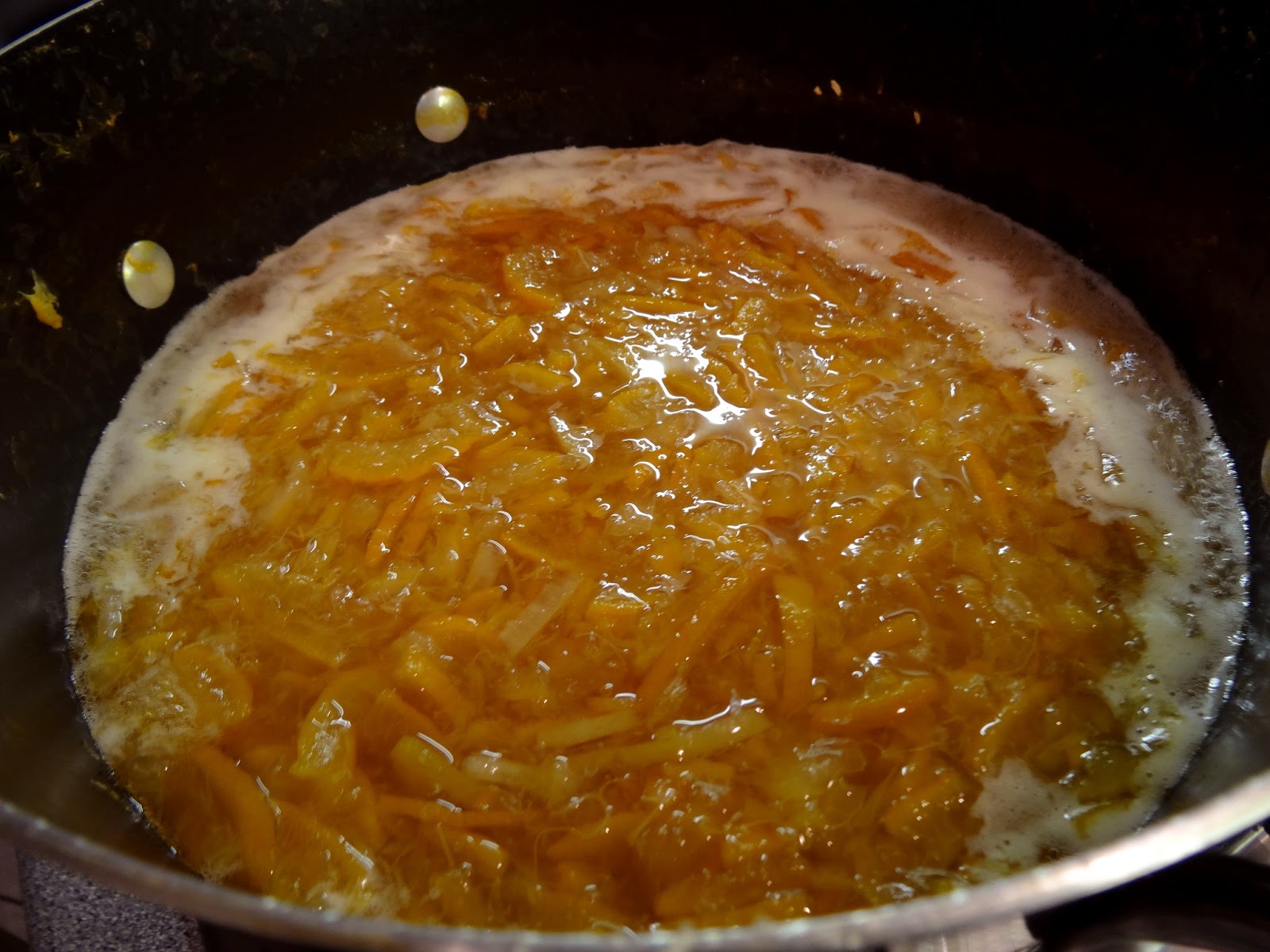
The next day, the peel, pulp, pips and water get transferred to a pan and boiled for about 2 hours until the peel is soft enough to squish between two fingers. After that, the bag of pips is removed, the sugar is added and the mixture is boiled (skimming off any froth that bubbles up) for 15-45 mins until set (this is tested by putting a tablespoon of the mixture on a saucer and chilling in the fridge for a few mins - if it forms a skin it's ready. Alternatively, use a sugar themometer - the setting point is 105C). When the marmalade boils it does tend to froth up, so you must have a big enough pan so that it won't bubble up over the sides, burning your hands and ruining your hob - I decided my stockpot wasn't quite big enough so I made the marmalade in two batches, straining the peel (but reserving the liquid) after the initial 2 hours of boiling, weighing out the peel and liquid into half quantities. Bit of a faff, so perhaps a big preserving pan might be a good investment in future! Once the marmalade has reached setting point, it's a good idea to leave it for 10 mins so that the peel is evenly distributed throughout the preserve.
| Marmalade comes up to the boil |
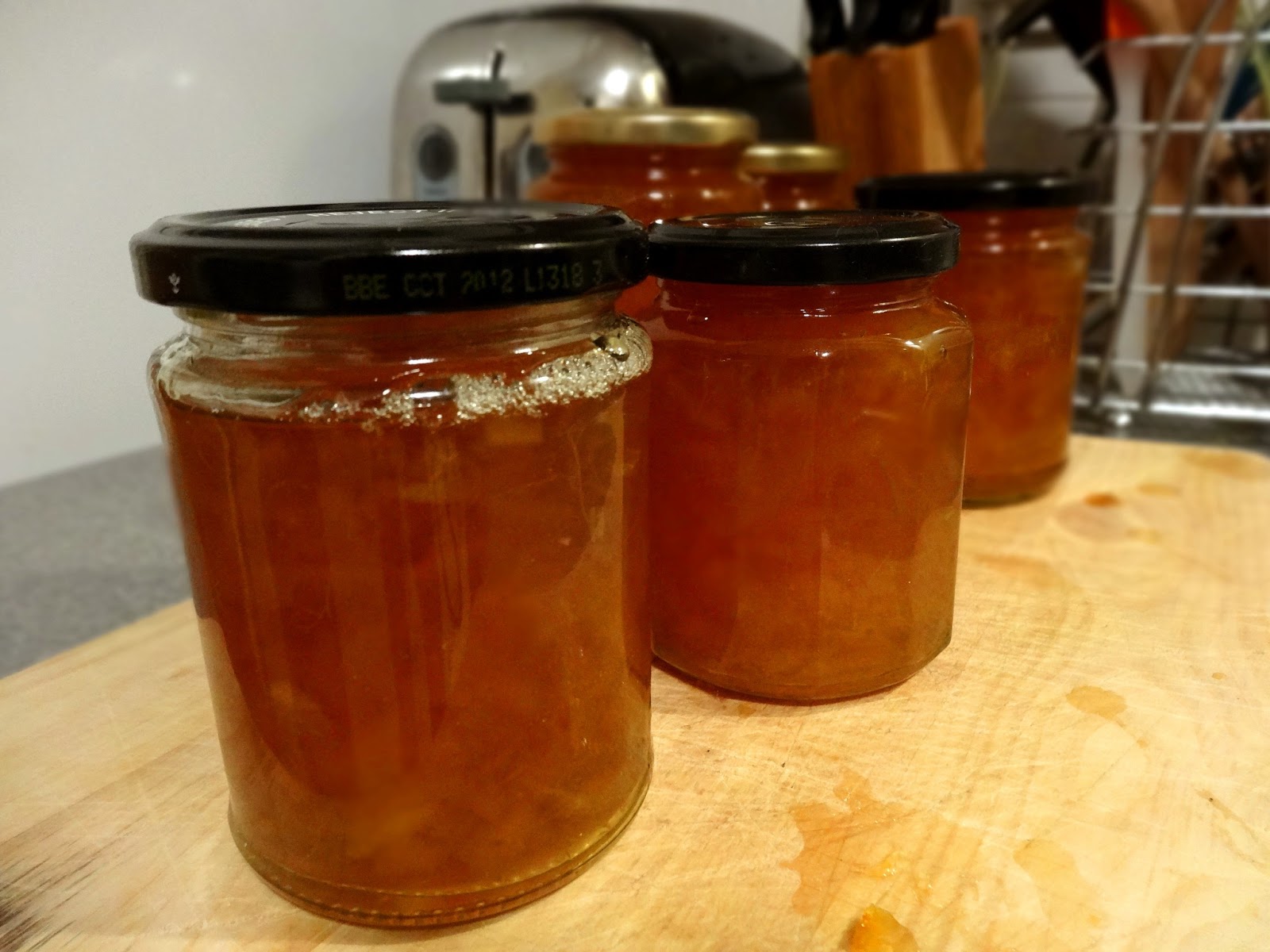
Finally, the marmalade is decanted into sterilised jars, and left to cool. After that, all you have to do is look forward to breakfast the next morning!
| Done! |
Friday, 18 January 2013
North East Food Heroes: NEOG
As part of a new monthly feature I'm going to focus on some of my favourite places to buy, eat and shop for food in the North East. I think we've got some amazing producers in this region, and as I hope I'm demonstrating in this blog, it's possible to eat extremely well even on a fairly low budget.
So, without further ado, my first 'North East Food Hero' is NEOG (North East Organic Growers)!
NEOG run a weekly organic veg bag scheme from their farm in Bomarsund, Northumberland. We have been receiving a weekly veg bag from them since June 2012, and even through an appallingly wet summer the quality and variety of veg has been terrific. They grow what they can themselves, and source the rest from a network of other organic farms, primarily local, with the occasional import during the less fruitful months (sourced as close as possible, and never air freighted). Veg bags are delivered weekly to a number of different links across the region (we pick ours up at St Thomas' Church in Newcastle city centre on a Wednesday). Buying our veg direct from growers helps to keep costs down (we pay £11 for a large bag, which provides the two of us with the vast majority of our weekly veg requirements). It also means we're often getting fresher veg than the supermarket could ever offer - carrots that left the ground hours rather than days ago, and sweet tasting freshly cut greens.
![]() |
| The contents of our NEOG bag in early September |
Having no control over what veg we get week to week might seem restricting, but in fact we have found it quite liberating - cooking with whatever the season provides helps us avoid the inevitable banality of mindlessly putting the same things in our shopping basket week after week. It forces us to be imaginative in the kitchen, consulting the cookbooks and throwing unusual combinations together. It also gives us, in the risk of sounding a little hippy-dippy, a sense of being in tune with the seasons - when we eat asparagus we know spring is here, when we eat courgettes we know that summer is in full swing, and when parsnips turn up in our bag we know the frosts have set in. Far from restricting our diet, it gives us ultimately more variety, with our way of eating changing from month to month.
NEOG also offer side orders of things like fruit, honey, organic eggs (we get bananas and lemons as part of our weekly order) at very reasonable prices. We've even had some of their gooseberries, which were delicious! If all this sounds like something you might be interested in then check out their website for information on how to start a trial. For me, they are true food heroes - organic vegetables, cheaper and fresher than you can buy in the supermarket, grown by people who care. What's not to like?!
Subscribe to:
Posts (Atom)